Advertising should optimize for business results, not proxy events. We came to that conviction while tackling one of the hardest problems in advertising: lead generation.
Unlike ecommerce, the outcomes that matter most in lead generation often happen offline and weeks after the click. A patient shows up, a student enrolls, an opportunity closes. Advertising platforms rarely receive enough of this data, and when they do, it often arrives too late to influence bidding.
We built Scowtt to predict those outcomes earlier and send the resulting signals back to advertising platforms.
As we scaled, we realized the same problem extended far beyond lead generation.
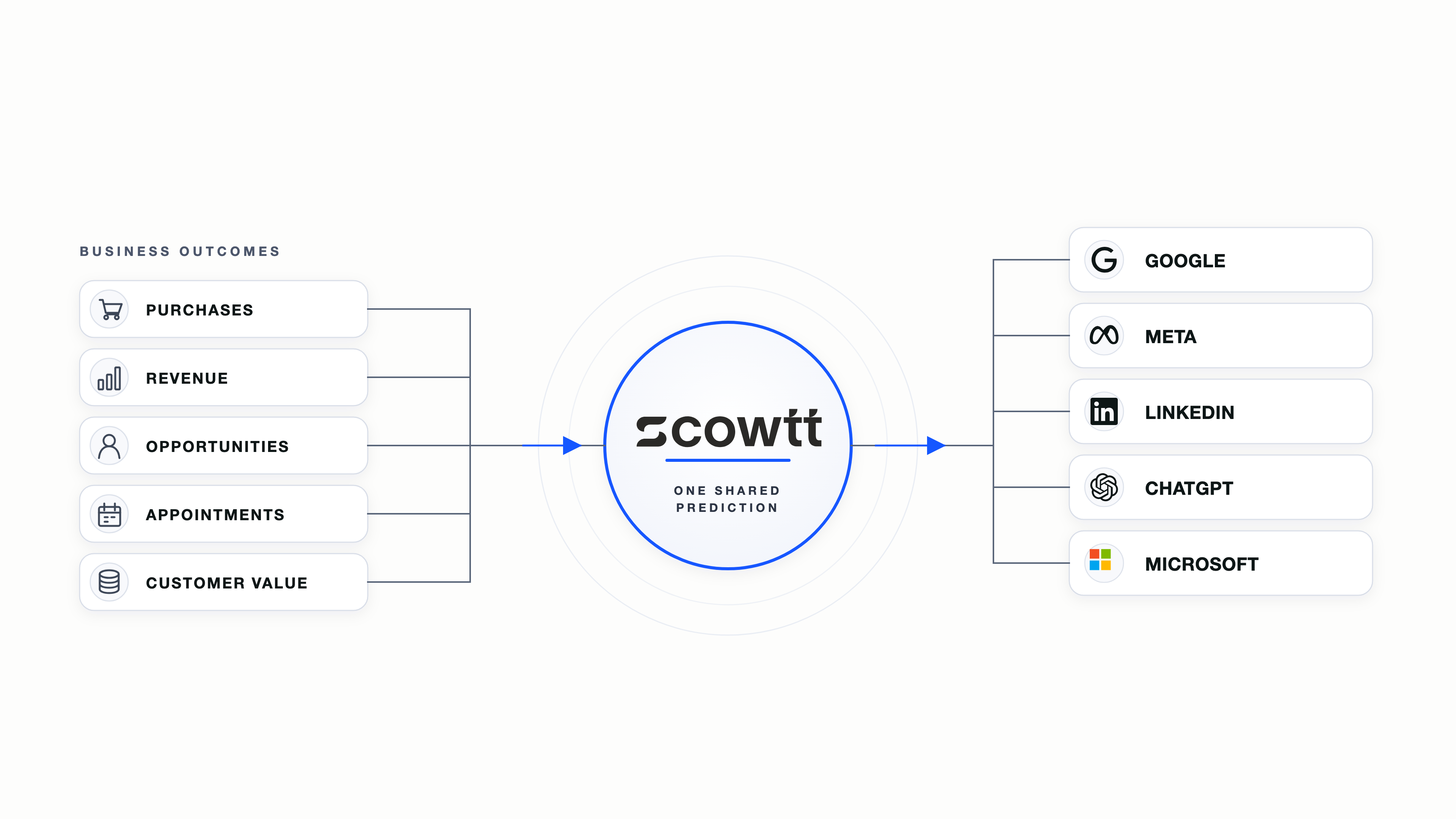
Scowtt can now help advertisers optimize toward a wide range of measurable outcomes: a qualified opportunity, store visit, test drive, subscription, membership, purchase, revenue, or long-term customer value.
That changes the objective of advertising.
Instead of asking marketers to translate business goals into clicks, leads, and other proxies, we can connect campaigns more directly to the metrics the business cares about.
Scowtt connects advertising decisions directly to business results. Once the feedback loop includes measurable downstream outcomes, campaigns can learn from more than the nearest available proxy.
The business objective, connected directly to advertising.
This also creates a stronger connection between brand and performance advertising.
Performance advertising has historically optimized toward conversions, while brand advertising has focused on reach, awareness, and brand lift.
They play different roles and operate on different timelines, but both are ultimately accountable to business growth.
When purchase is the goal, a company's own outcome data can help advertising systems identify the audiences most likely to buy and improve those predictions over time. That creates a shared feedback loop without pretending brand building and performance marketing are the same discipline.
The opportunity is especially large in industries where the company creating demand does not own the transaction.
Automotive, entertainment, pharmaceuticals, and consumer goods all face versions of this challenge. Outcome data may exist for measurement or targeting, yet remain disconnected from campaign optimization. Closing that gap can make marketing more efficient.
An automotive OEM builds the brand, but a dealer sells the car. A studio markets a movie, but a theater or ticketing platform sells the ticket. An electronics brand builds demand through reach campaigns, but the purchase happens at a retailer such as Costco. The same pattern appears across many other categories.
Historically, that separation has broken the feedback loop.
A conversion does not need to happen on your website for your advertising to learn from it.
For years, businesses have translated their objectives into the limited signals advertising platforms can understand.
We think the system should work the other way around.
Advertising should learn the language of the business and work toward the result the business values.
That is the system we are building at Scowtt.